

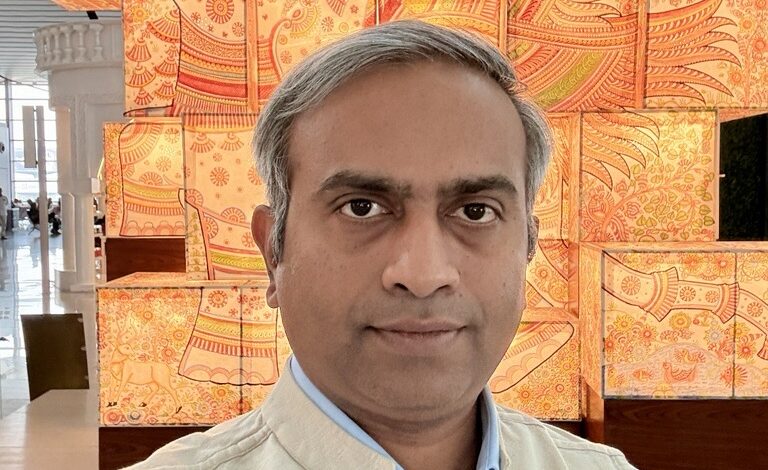
Niranjan R. Manjrekar, Managing Director, LVD-Multifold Pvt. Ltd., on technology, automation and customer-centric innovation shaping the future of Indian manufacturing
How LVD-Multifold is advancing manufacturing excellence through automation, integrated technologies and customer-focused innovation.

- India aspires to become a global manufacturing hub. What are the biggest opportunities and challenges for the Indian machine tool industry in achieving global competitiveness, and what changes are still required?
India’s ambition to become a global manufacturing hub cannot be achieved without a globally competitive machine tool industry. Machine tools determine the productivity, precision, quality, and cost competitiveness of every manufacturing sector.India is one of the world’s fastest-growing manufacturing markets. Defence indigenization, semiconductor manufacturing, EV production, railway modernization, and infrastructure expansion are creating significant demand for advanced machine tools.
Global manufacturers are actively diversifying supply chains beyond China. India has a unique opportunity to become a preferred manufacturing destination for multinational companies seeking resilience and geopolitical diversification. This directly benefits demand for CNC machining centres, sheet metal processing equipment, automation systems, and precision manufacturing technologies.
India has a historic opportunity. Demand drivers are strong, geopolitical shifts are favorable, and manufacturing investment is accelerating. However, global competitiveness in machine tools will not come from market size alone. It will require deep capability in precision engineering, indigenous technology, R&D, automation, skilled talent, and component ecosystems.
In my view, the single most important shift required technology ownership. Once India develops globally competitive capabilities in CNC controls, spindles, servo systems, software, and precision engineering, the machine tool industry can become not just a beneficiary of India’s manufacturing growth, but one of its primary enablers.
- Innovation today extends beyond products. How is your organisation driving innovation across manufacturing processes, customer experience, sustainability, workforce development or digital transformation?
Innovation today goes far beyond building better machines. At LVD, we view innovation as creating greater value across the customer’s entire manufacturing ecosystem, helping them become more productive, profitable, sustainable, and future-ready.
LVD has evolved from being a machine supplier to becoming a provider of integrated manufacturing solutions. Our laser cutting systems, press brakes, panel benders, punching machines, and automation solutions are designed to work together as a connected production environment. Through automation, adaptive process control, offline programming, and integrated software platforms, we help customers reduce setup times, improve throughput, and achieve consistent quality regardless of operator skill levels.
LVD’s software ecosystem enables customers to connect engineering, production planning, machine operation, and performance monitoring into a single workflow. Real-time production visibility, data-driven decision-making, remote diagnostics, and predictive maintenance capabilities help customers increase uptime and improve operational efficiency.
Customer expectations have changed dramatically over the last decade. Today, customers expect apartner who can help solve productivity challenges, support process optimization, and deliver measurable business outcomes. At LVD, we focus on providing complete application support, process consulting, training, service responsiveness, and lifecycle support. Our objective is to help customers achieve the lowest cost per part and the highest return on investment rather than simply selling equipment.
Sustainability is no longer a compliance exercise. It has become a competitive advantage. LVD supports sustainable manufacturing through: Energy-efficient machine designs, Higher material utilization and reduced scrap generation, Automation that minimizes waste and rework, longer equipment life cycles, Optimized production processes that reduce overall resource consumption. Many customers are now tracking their environmental footprint, and technology must contribute toward both productivity and sustainability goals simultaneously.
One of the biggest challenges facing manufacturing globally is the shortage of skilled talent. LVD addresses this by developing machines and software that are easier to operate, faster to learn, and less dependent on highly specialized operators. At the same time, we invest significantly in customer training, technical education, and competency development. The future workforce will need a combination of manufacturing knowledge, digital skills, automation expertise, and data literacy. As technology providers, we have a responsibility to help bridge that gap.
Looking ahead, we see innovation increasingly driven by the convergence of: Automation, Artificial Intelligence, Data analytics, connected manufacturing, Flexible production systems Customers want greater agility because product lifecycles are becoming shorter and customization demands are increasing. LVD’s innovation strategy is therefore focused on helping manufacturers produce more complex products, with greater flexibility, higher quality, and lower operating costs.
- Manufacturing success increasingly depends on collaboration across OEMs, suppliers, technology providers, academia and startups. How do you see partnerships shaping the future of manufacturing, and what role does your organisation play in this ecosystem?
No single company, regardless of its size or expertise, can drive the next phase of manufacturing transformation alone. The complexity of modern manufacturing, spanning automation, digitalization, AI, sustainability, advanced materials, and workforce development, requires a highly collaborative ecosystem.
Traditionally, manufacturing success was driven by individual companies optimizing their own operations. Today, competitiveness is increasingly determined by how effectively organizations collaborate across the value chain. OEMs, suppliers, machine tool manufacturers, software providers, automation specialists, academic institutions, research centers, and startups each bring unique strengths. When these capabilities come together, innovation cycles become shorter, technology adoption accelerates, and manufacturers can respond more effectively to rapidly changing market demands. Going forward, I believe the most successful manufacturing ecosystems will be those that combine industrial expertise, digital intelligence, and innovation networks rather than operating in isolation. A laser cutting machine, press brake / Panel Bender, warehouse system, ERP platform, and production management software must communicate seamlessly to deliver the full benefits of Industry 4.0. This requires deep collaboration between machine builders, software developers, automation companies, and systems integrators. No customer today is looking for a standalone machine. They are looking for integrated solutions that improve productivity, flexibility, traceability, and business outcomes.
As a result, open partnerships and interoperable technologies will become even more important in the years ahead.
At LVD, we see ourselves not simply as a machine manufacturer but as a technology partner helping customers build smarter and more connected factories.
Our role extends beyond supplying laser cutting systems, press brakes, punching machines, panel benders, and automation solutions. We work closely with customers, software providers, automation partners, tooling suppliers, educational institutions, and industry associations to create integrated manufacturing solutions. Our objective is to help customers achieve higher productivity, improved quality, lower operating costs, and greater manufacturing flexibility.
LVD contributes through integrated software platforms, automation systems, data-driven production management, and connected manufacturing solutions.
We believe that the greatest value is created when machines, software, and people work together within a unified ecosystem. This requires collaboration not only with customers but also with technology partners across the manufacturing landscape.
- Looking ahead to 2030, what will define a successful machine tool company? Which capabilities, technologies or leadership qualities will differentiate the industry’s future leaders?
This conversation will increasingly shift from “What machine should I buy?” to “How can I improve my entire manufacturing operation?” Software will become as important as hardware.
Future MTB leaders will offer integrated ecosystems that connect design, programming, production planning, machine operation, quality control, and factory analytics. Real-time data, AI-driven optimization, predictive maintenance, and digital twins will become standard expectations rather than differentiators.
The global shortage of skilled manufacturing talent is unlikely to disappear by 2030. As a result, automation will become a necessity rather than an option. Priority Focus will be in delivering complete automation solutions that combine machines, robotics, material handling, software, and process intelligence into seamless production systems. Customers will increasingly prefer partners who can provide integrated solutions rather than managing multiple suppliers independently.
The most successful companies will not simply sell equipment; they will become trusted manufacturing advisors. Customers in aerospace, automotive, electronics, medical devices, energy, and sheet metal fabrication increasingly require solutions tailored to their specific applications. Deep industry knowledge, process expertise, and consulting capabilities will become major competitive differentiators.
Sustainability will increasingly influence investment decisions. Manufacturers are under growing pressure to reduce energy consumption, material waste, carbon emissions, and resource usage. Machine tool companies that help customers achieve both productivity and sustainability objectives will enjoy a significant competitive advantage.
Manufacturing is becoming more dynamic. Product lifecycles are shortening, customization requirements are increasing, and market conditions are changing more rapidly than ever before. Companies that can innovate faster, adapt quickly to new technologies, and respond rapidly to customer needs will outperform those relying on traditional development cycles.
Partnerships with startups, research institutions, technology providers, and customers will become critical sources of innovation.
By 2030, the most successful leaders will be deeply focused on customer outcomes rather than product features.
They will ask:
- How can we reduce our customers’ cost per part?
- How can we improve their productivity?
- How can we help them overcome labor shortages?
- How can we support their sustainability goals?
The companies that consistently solve customer problems will earn long-term loyalty and market leadership.
In my view, the defining characteristic of a successful machine tool company in 2030 will be its ability to combine engineering excellence, digital intelligence, automation expertise, sustainability leadership, and customer-centricity. The future leaders will not be known simply for building the best machines. They will be recognized for enabling the best manufacturing outcomes. Ultimately, the winners will be those who help manufacturers become smarter, more flexible, more sustainable, and more competitive in an increasingly connected global economy.
- As one of the Machine Tool Influencers 2026, what message would you like to share with the next generation of manufacturing professionals and entrepreneurs who will shape India’s industrial future?
As someone who has spent decades in the machine tool and manufacturing industry, my message to young professionals and entrepreneurs is simple: This is the most exciting time in history to be part of manufacturing. For the first time in decades, India has a genuine opportunity to emerge as a global manufacturing powerhouse. The decisions, innovations, and businesses created by today’s young engineers, technologists, and entrepreneurs will determine whether India merely participates in global manufacturing or helps lead it.
Think Beyond Cost, Think Global Competitiveness. India’s future cannot be built solely on low-cost manufacturing.
The next generation must focus on:
- Innovation rather than imitation
- Productivity rather than only capacity
- Quality rather than volume
- Technology leadership rather than technology adoption
The future belongs to innovators who can transform ideas into solutions that improve productivity, sustainability, and competitiveness at the same time embrace Continuous Learning. The manufacturing industry is evolving faster than ever before. The skills that are valuable today may need to be reinvented tomorrow. Therefore, cultivate a mindset of lifelong learning. Stay curious about new technologies, new materials, automation, data analytics, sustainability, and emerging business models. The future of manufacturing will be built through collaboration. No company, institution, or individual can innovate alone. The strongest ideas will emerge from partnerships between industry, academia, startups, technology providers, and customers.
The factories of the future will be judged not only by what they produce, but by how responsibly they produce it.
Don’t aspire only to operate world-class factories. Aspire to build world-class technologies, create globally respected brands, develop breakthrough innovations, and make India a source of manufacturing excellence for the world.
India’s industrial future will not be defined by the technologies we import, but by the technologies we invent, the companies we build, and the talent we nurture.
The next chapter of Indian manufacturing is waiting to be written. I am confident that the next generation has the ambition, capability, and courage to write a remarkable one.


