From Measurement to Manufacturing Intelligence: Enabling India’s Next Leap in Precision Manufacturing
Dr. Sanjeev Kumar, Renishaw India, on precision manufacturing, process control, digital transformation and building India’s next generation of intelligent manufacturing capabilities.

1) India aspires to become a global manufacturing hub. What are the biggest opportunities and challenges for the Indian machine tool industry in achieving global competitiveness, and what changes are still required?
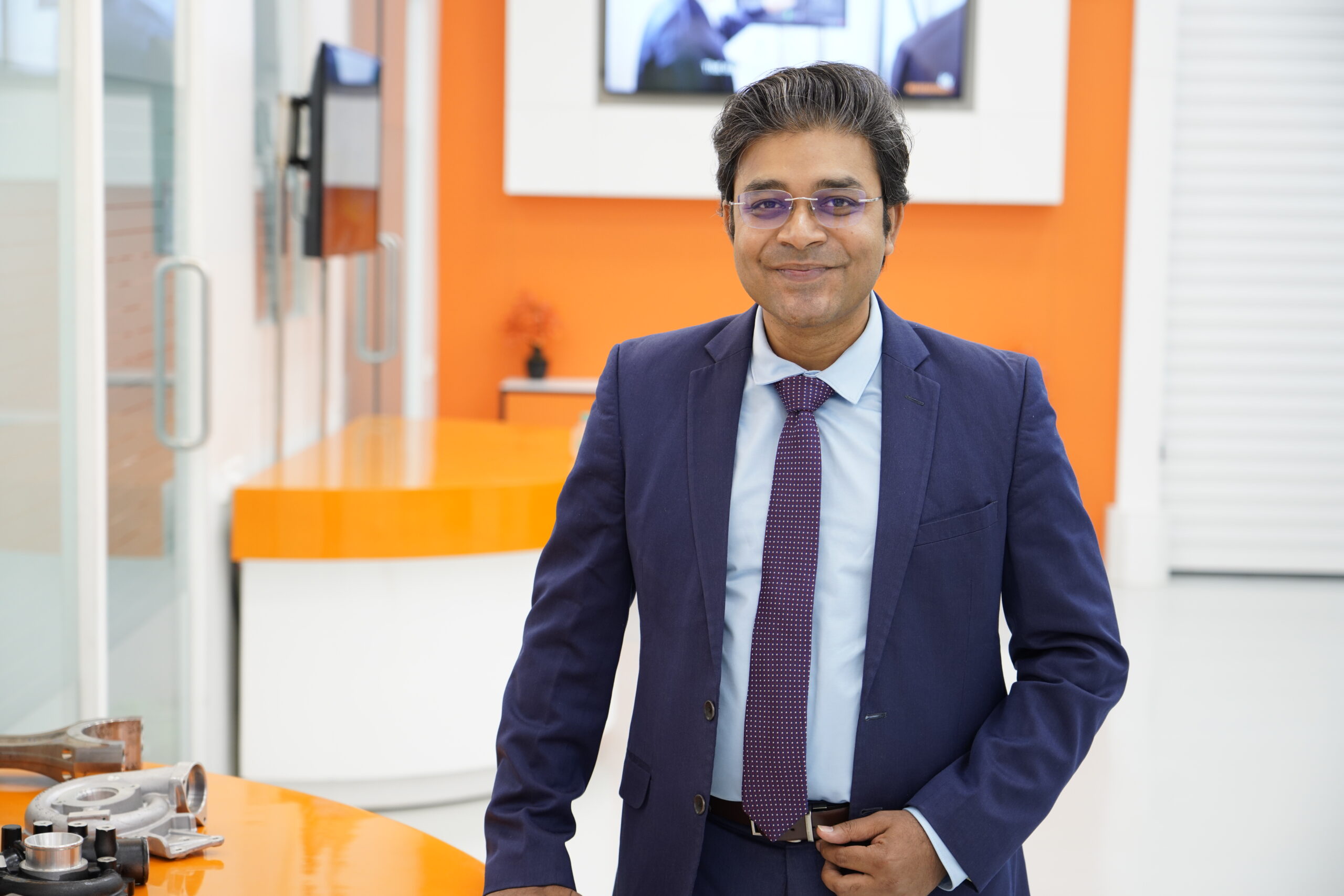
Dr Sanjeev says that India has the market, engineering talent and industrial ambition to become a global manufacturing hub. The opportunity is strong across automotive, aerospace, defence, electronics, semiconductors and precision engineering. But global competitiveness will depend on how quickly we move from manufacturing capacity to consistent manufacturing capability.
The market is also changing. Customers are no longer looking at a machine as a standalone investment. They expect a complete manufacturing solution that delivers productivity, repeatability, traceability and lower operating risk.
For the machine tool industry, this means building more intelligence and control into the machining process. Machine calibration establishes the foundation. Probing and tool-setting systems automate set-up and identify variation at the source. Shop floor gauging and software-enabled process control help manufacturers act on measurement data before time and material are lost.
This is also the direction Renishaw is taking. We are building on our strength in sensors and increasing the technology value through connected systems, software and smart factory solutions.
India’s next step is not simply to manufacture more. It is to manufacture with greater control, fewer resources and more confidence. That is what will make India a trusted global manufacturing partner.
2) Innovation today extends beyond products. How is your organisation driving innovation across manufacturing processes, customer experience, sustainability, workforce development or digital transformation?
Sanjay remarks, at Renishaw, innovation is not only about developing a new product. It is about increasing the value that technology creates across the complete manufacturing process.
We are building on our strength in precision sensors and moving towards a full-stack technology approach, bringing together systems, software, automation and smart factory solutions. Technologies such as machine calibration, probing, tool setting, shop floor gauging, CMM systems and Renishaw Central help manufacturers understand machine performance, control variation and make better use of production data.
But technology alone is not enough. We are also improving customer experience through our technology centres, demonstrations, application engineering, training and local support. High-value technology needs strong engineering support. Customers must be able to understand the solution, prove it in their application and integrate it into their production environment.
The same approach supports sustainability. Better process control reduces scrap, rework, energy use and unnecessary machine investment. For us, innovation means creating a stronger manufacturing outcome: connected processes, skilled people, better decisions and greater value from every production asset.
3) Manufacturing success increasingly depends on collaboration across OEMs, suppliers, technology providers, academia and startups. How do you see partnerships shaping the future of manufacturing, and what role does your organisation play in this ecosystem?
Manufacturing is becoming more connected, and no company can deliver the complete solution alone, adds Dr Sanjeev. The future will depend on partnerships that bring machines, measurement, software and automation together around the customer’s production needs.
Machine tool builders bring machine capability. Automation companies bring integration and material movement. Software providers connect information. Technology providers bring measurement and process control. Academia and startups bring new ideas and specialist knowledge. The strongest results come when all these capabilities are connected around one real customer requirement.
Renishaw’s role is to add precision, feedback and intelligence to this ecosystem. We work with machine tool builders to integrate probing, tool measurement and process control technologies. We work with automation providers to ensure that measurement supports automated production rather than remaining a separate activity. We work with customers to understand the application and prove the manufacturing outcome. We work with channel partners to take this capability closer to regional industries.
This collaborative model is important as Renishaw increases its focus on high-value systems, software and smart factory solutions. No high-value solution succeeds through hardware alone. It needs application understanding, integration, training, service and long-term support.
Our technology centres in India provide a practical platform for this collaboration. Customers, machine tool builders, partners and engineers can see technologies working together, test applications and build confidence before implementation.
As Renishaw extends into industrial automation and other close-adjacent markets, partnerships will become even more central to our growth. We do not want to own every part of the factory. We want to bring Renishaw’s precision, engineering and process knowledge into the right partnerships and help create a stronger complete solution.
4) Looking ahead to 2030, what will define a successful machine tool company? Which capabilities, technologies or leadership qualities will differentiate the industry’s future leaders?
By 2030, growth in Indian manufacturing will attract many players. The real test will be who can convert that growth into long-term value, says Sanjay.
Successful machine tool companies will make three clear choices. They will strengthen their position in established markets, increase the technology value around their core products, and enter new markets where their engineering strengths give them a real advantage. Trying to compete everywhere, without a clear technology position, will not be sustainable.
For India, this means moving beyond building machines at a competitive price. The industry must create more intellectual property, develop stronger software and automation capability, and take greater ownership of the complete manufacturing process. Companies will also need to help customers improve existing production assets, not only sell new ones.
Renishaw is following this direction. We continue to build on our leadership in precision sensors, while developing higher-value systems that combine calibration, probing, gauging, motion control, software and manufacturing data. We are also extending our capabilities into industrial automation and close-adjacent markets where our precision engineering can create new value.
The future leaders will be commercially focused, but they will not sacrifice long-term innovation for short-term growth. They will invest in engineering, people and in-house capability, while making disciplined decisions about where they can genuinely lead.
5) As one of the Machine Tool Influencers 2026, what message would you like to share with the next generation of manufacturing professionals and entrepreneurs who will shape India’s industrial future?
My message is simple: do not build a manufacturing business around a machine. Build it around the value that the complete process can deliver, highlights Dr Sanjeev.
The next generation will have access to AI, robotics, connected systems, digital twins and advanced manufacturing technologies. But technology itself is not the advantage. The advantage comes from knowing where to apply it and what value it must create.
Stay close to the shop floor. Understand why a process varies. Understand what creates rejection. Understand the cost of downtime, manual dependency and late measurement. These are the real problems behind manufacturing competitiveness.
At the same time, think bigger than individual products.
A sensor may capture information. Software may interpret it. Automation may act on it. A high-value solution brings these capabilities together and creates a measurable business outcome.
These systems thinking will be critical for India. We have already proved that India can manufacture at scale. The next step is to become globally recognised for high-value, high-precision and technology-led manufacturing. That means moving beyond cost-based competition and building businesses around productivity, quality, innovation and trust.
For young entrepreneurs, the opportunity is not only to replicate what already exists. Look at manufacturing machine performance, industrial automation, electrification, digitalisation and decarbonisation. These are areas where new technologies, new business models and new partnerships can create real long-term value.
Be ambitious but remain practical. Respect engineering fundamentals. Use data carefully. Build strong partnerships. Invest in people. Most importantly, solve a problem that matters to the customer.
India’s industrial future will be shaped by people who can connect technology with real manufacturing value.
“Renishaw is moving from individual technologies to high-value manufacturing solutions that connect precision, software, automation and data – Sanjay Sangam”
About Renishaw
Renishaw is a world leading supplier of measuring systems and manufacturing systems. Its products give high accuracy and precision, gathering data to provide customers and end users with traceability and confidence in what they’re making. This technology also helps its customers to innovate their products and processes.
It is a global business with over 5,000 employees located in the 36 countries where it has wholly owned subsidiary operations. The majority of R&D work takes place in the UK, with the largest manufacturing sites located in the UK, Ireland and India.
For the year ended June 2024 Renishaw recorded sales of £691.3 million of which 95% was due to exports. The company’s largest markets are China, USA, Japan and Germany.
Renishaw is guided by its purpose: Transforming Tomorrow Together. This means working with its customers to make the products, create the materials, and develop the therapies that are going to be needed for the future.
Further information at www.renishaw.com