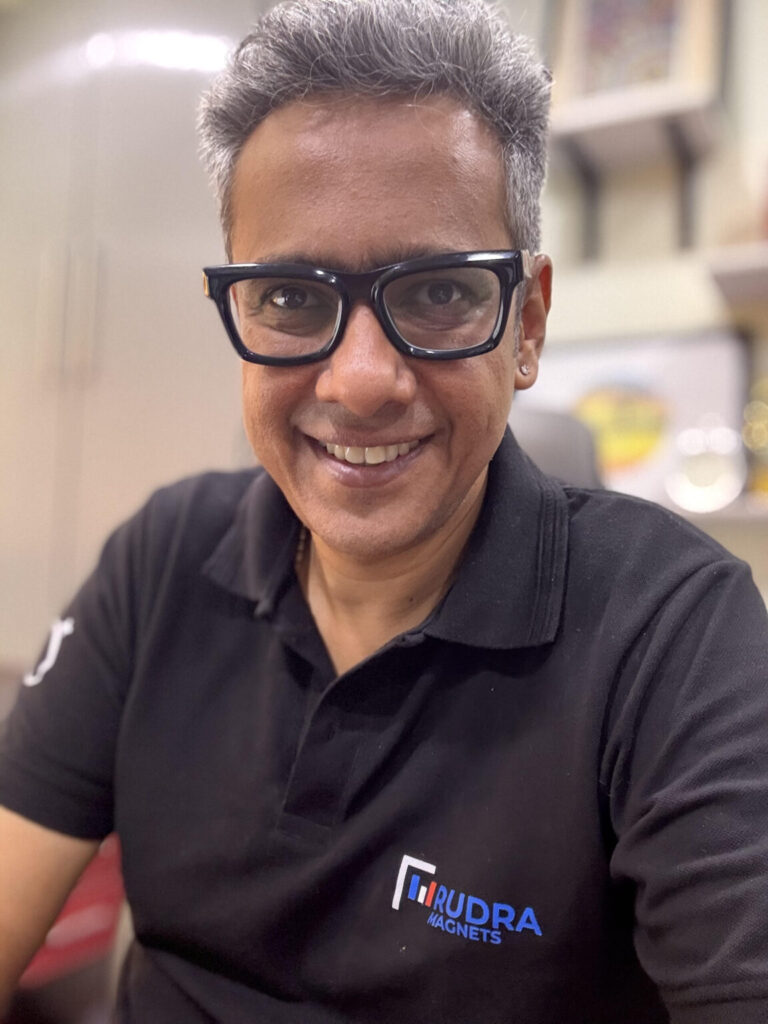
From Magnetic Technology to Manufacturing Intelligence: Building Smarter, Safer and More Productive Factories
Dhiruj Sarda, Director, East Coast Magnets Private Limited, on intelligent magnetic solutions, MAGNAiQ™, technology-led innovation and India’s journey towards global manufacturing leadership

1. The machine tool industry is undergoing rapid transformation. Which technological trends—such as AI, automation, digital manufacturing or precision engineering—do you believe will have the greatest impact over the next five years, and how is your organisation preparing for them?
Manufacturing is moving beyond automation towards intelligence. Over the next five years, I believe the biggest transformation will come from manufacturing systems that not only perform a task but also understand what is happening in real time and respond intelligently.
At Rudra Magnets, we don’t see ourselves merely as a manufacturer of magnetic products.
We see ourselves as a production improvement solution provider, helping manufacturers improve productivity, safety, quality and energy efficiency through intelligent magnetic technology.
Our Electro Permanent Magnetic solutions already eliminate continuous power consumption while providing fail-safe operation. Building on this foundation, we have developed MAGNAiQ™—our intelligent magnetic sensing and analytics platform.
Today, MAGNAiQ is already integrated into our EPPRESS™ magnetic quick mould change systems and our SAFEBAT™ battery-operated lifting magnets, where it continuously monitors the magnetic holding condition and provides real-time feedback to ensure the mould or load remains securely held throughout the operation.
Our next major milestone is extending MAGNAiQ™ to MAGNASLOT™, our magnetic workholding solution for CNC machining. This is significantly more challenging because machining is a constantly changing process, with cutting forces, vibration, tool engagement and workpiece geometry varying every second.
We are developing proprietary software and sensing algorithms capable of analysing magnetic behaviour in real time to estimate effective clamping forces across the workpiece, determine the machining loads that can be safely sustained and warn operators whenever safety margins are being approached. In the future, when integrated with CNC controls, the system will even be capable of automatically pausing machining before workholding integrity is compromised.
Whether this is ultimately classified as Artificial Intelligence or advanced engineering analytics is less important than the outcome. Our goal is simple—to make magnetic systems intelligent enough to help manufacturers make better decisions, improve productivity and operate more safely.
2. India aspires to become a global manufacturing hub. What are the biggest opportunities and challenges for the Indian machine tool industry in achieving global competitiveness, and what changes are still required?
India has all the ingredients to become a global manufacturing powerhouse—exceptional engineering talent, entrepreneurial energy, a large domestic market and strong policy support through initiatives such as Make in India and Atmanirbhar Bharat.
The opportunity now is to move beyond being recognised for cost competitiveness and become known for technology leadership, innovation and engineering excellence.
To achieve this, Indian manufacturers must invest more aggressively in research and development, intellectual property, precision manufacturing and globally accepted quality standards. Equally important is stronger collaboration between industry, academia and technology partners to accelerate innovation.
At Rudra Magnets, we invest approximately 1% of our annual revenue in research and development, with a clear commitment to increase this to 2% over the next year as we continue developing proprietary technologies such as MAGNAiQ™ .
We firmly believe that India’s long-term competitiveness will not be built on lower costs alone, but on creating technologies that solve manufacturing problems better than anyone else.
The future belongs to companies that own technology, build intellectual property and continuously innovate.
3. Innovation today extends beyond products. How is your organisation driving innovation across manufacturing processes, customer experience, sustainability, workforce development or digital transformation?
Innovation begins with asking a very simple question:
“How much have we improved our customer’s production?”
Every product we develop is evaluated not only on its technical performance but on how much it reduces setup time, improves operator safety, increases machine utilisation, reduces energy consumption and delivers measurable productivity improvements.
Our Electro Permanent Magnet technology already reduces energy consumption by over 90% compared to conventional electromagnets while maintaining fail-safe operation.
Beyond hardware, we are investing heavily in intelligent software through MAGNAiQ™, transforming magnetic systems from passive devices into intelligent manufacturing assets capable of providing real-time process information.
Internally, we continue investing in advanced manufacturing equipment, digital engineering tools, process standardisation and continuous skill development. Innovation is not a department within our organisation—it is a culture that influences every engineering decision, every manufacturing process and every customer interaction.
4. Manufacturing success increasingly depends on collaboration across OEMs, suppliers, technology providers, academia and startups. How do you see partnerships shaping the future of manufacturing, and what role does your organisation play in this ecosystem?
Modern manufacturing is becoming increasingly interdisciplinary. Mechanical engineering, electronics, software, sensors, automation and data analytics are converging, making collaboration essential rather than optional.
No single organisation can master every technology independently.
We actively collaborate with machine tool builders, automation companies, robotics integrators, crane manufacturers, research institutions and our customers to develop application-specific solutions that improve manufacturing performance.
The most valuable partnerships are those where engineering knowledge is shared openly and success is measured not by the products sold but by the productivity improvements achieved together.
When different organisations contribute their strengths towards solving a common industrial problem, everyone benefits—especially the customer.
5. Looking ahead to 2030, what will define a successful machine tool company? Which capabilities, technologies or leadership qualities will differentiate the industry’s future leaders?
By 2030, successful companies will no longer be defined only by the machines they manufacture but by the intelligence they embed into those machines.
Customers will increasingly expect equipment that is connected, self-monitoring, energy efficient and capable of providing meaningful production insights.
Future leaders will combine world-class engineering, intelligent software and deep application knowledge to deliver complete manufacturing solutions rather than individual products.
Leadership itself must also evolve. Great leaders will encourage curiosity, invest consistently in research, empower engineers to experiment and build organisations where innovation becomes a daily habit rather than an annual objective.
Technology can always be purchased.
A culture of innovation must be built.
6. As one of the Machine Tool Influencers 2026, what message would you like to share with the next generation of manufacturing professionals and entrepreneurs who will shape India’s industrial future?
First of all, it is a privilege to be included in this feature. I have never considered myself an influencer.
If our journey has inspired others in any way, I hope it is through curiosity, perseverance and an unwavering commitment to solving real manufacturing problems.
Manufacturing has never been more exciting.
Today’s engineers have the opportunity to combine mechanical engineering, electronics, software and data science to create technologies that can genuinely transform industries.
One thought I always like to share is that people often quote:
“Curiosity killed the cat.”
But they forget the second half:
“…but satisfaction brought it back.”
Curiosity has never been the problem.
The real challenge today is that we often stop too early. We live in a world of headlines, short attention spans and half knowledge. Engineering demands exactly the opposite. Real innovation comes from asking one more question, looking one level deeper and refusing to stop until you truly understand the problem.
To every young engineer and entrepreneur, my advice is simple: stay curious, stay humble and never stop learning. The day you believe you know everything is the day innovation stops.
India has the talent and the opportunity to become a global manufacturing leader. Our responsibility is not simply to manufacture products—it is to create technologies that improve productivity, conserve energy, enhance safety and leave the next generation with a stronger manufacturing ecosystem than the one we inherited.
Do Visit – https://www.eastcoastmagnet.com/