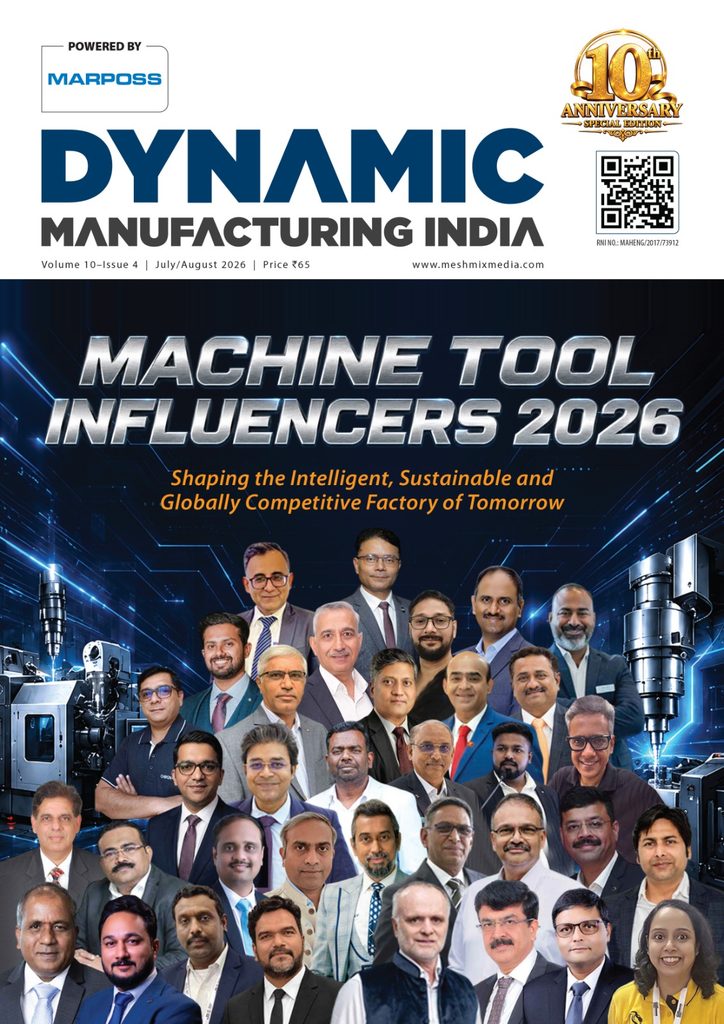
Machine Tool Influencers 2026: Hrishikesh Kulkarni on Smart Automation
Hrishikesh Kulkarni, COO, Zimmer Group India – Driving the Next Generation of Smart and Flexible Automation

Beyond simple automation, what are the most impactful advanced robotic applications currently being deployed in manufacturing processes, and what specific business problems do they solve?
At Zimmer Group, we see the next phase of industrial automation moving beyond simple pick-and-place applications towards intelligent, flexible and highly integrated robotic systems. The biggest impact is coming from applications where robots can adapt to product variation, communicate process data and perform multiple operations with minimal human intervention.

Intelligent End-of-Arm Tooling and Smart Gripping: One of the most impactful developments is the use of smart grippers with integrated sensing and IO-Link communication. These systems can monitor gripping position, status, air pressure and operating cycles in real time, enabling condition monitoring and early detection of process deviations. Zimmer’s smart pneumatic grippers can deliver up to 50% shorter cycle times and up to 90% lower compressed-air consumption, depending on the application.
The business problem being addressed is not merely labor reduction is improving throughput, reducing energy consumption, preventing quality issues and increasing machine availability.
Flexible Multi-Product Manufacturing: With the wide range of automatic tool changers, robots can automatically switch between different grippers and tools. This is particularly valuable in automotive and general manufacturing, where one production line increasingly needs to handle multiple variants and smaller batch sizes.
The key business benefit is reduced changeover time and greater asset utilization, allowing manufacturers to achieve flexibility without investing in dedicated automation for every product variant.
From our experience – the objective is to move from “automating a task” to “optimizing the entire process.”
What are the key considerations for manufacturers when evaluating the ROI of different automation and robotics solutions? How do factors like upfront investment, maintenance costs, and potential productivity gains influence decision-making?
The first consideration is, of course, upfront capital expenditure—the robot, EOAT, tooling, safety systems, integration and programming. However, a lower purchase price does not necessarily mean a better ROI. A slightly higher initial investment can often be justified if the solution delivers higher productivity, greater flexibility, lower maintenance and longer operating life.
The second and increasingly important factor is productivity gain. Manufacturers should quantify improvements in cycle time, machine utilization, throughput, changeover time and the ability to operate multiple shifts.
Maintenance and uptime are equally important. A robotic cell that is technically capable of high output but suffers from frequent stoppages will not deliver the expected ROI. Zimmer’s GPP/GPD5000 grippers, for example, are designed for up to 30 million maintenance-free cycles, while integrated diagnostics can help identify issues earlier and support predictive maintenance.
Looking ahead, what are the most significant technological advancements in robotics and automation that you anticipate will have the greatest impact on the manufacturing sector over the next 5-10 years? What strategic steps should manufacturers be taking now to prepare for these changes?
AI will increasingly move from the software layer into the physical world. Combining AI with machine vision, force sensing and real-time process data will enable robots to handle greater product variation, recognize objects, detect quality deviations and optimize their own movements. The International Federation of Robotics identifies analytical, generative and physical AI as major drivers of the next generation of robotics.
For manufacturers, this could fundamentally change the economics of automation by making it viable for high-mix, low-volume production, where conventional fixed automation has historically been difficult to justify. We expect mobile robots and mobile manipulation to become increasingly integrated into production, intralogistics and machine-tending applications. Instead of automating one workstation in isolation, manufacturers will increasingly look at automating the flow of materials between processes. The longer-term opportunity is a factory where robots can move, manipulate, inspect and interact with different machines and processes.
What are the biggest challenges companies face in integrating robotics and automation technologies into existing production lines?
The first challenge is integration with existing equipment and processes. Different machines, robots and control systems often use different interfaces and communication protocols. Zimmer Group addresses this through a broad portfolio of compatible automation components, industrial communication technologies and system solutions, enabling customers to develop solutions that can be integrated into existing production environments. Our approach covers everything from individual grippers and tool changers to complete automation systems.
The second challenge is achieving flexibility without making the automation excessively complex. Manufacturers today need to handle more product variants, shorter batches and frequent changeovers. Zimmer addresses this with modular and scalable solutions, including intelligent grippers, automatic tool-changing systems and flexible EOAT solutions. The objective is to allow one automation platform to perform multiple tasks rather than creating a dedicated system for every product.
In order to support customers in setting up efficient automations solutions, Zimmer-Group India has set up a manufacturing facility with production capabilities, engineering infrastructure, a quality-control facility, training and demonstration areas, and a Customer Experience Center. Our customers have benefited as they get an opportunity to work on POC’s and leverage Zimmer Group’s global technology and application expertise and Zimmer Group India’s local engineering, manufacturing and customer-support capabilities in India.
do Visit – https://www.zimmer-group.com/en/